Inclusive Playground Design: Markings That Work for Every Child
Inclusive playground design means planning a school playground so that children of all abilities, communication styles and emotional needs, including pupils with SEND, can play, learn and make friends side by side. For most schools, well-planned playground markings are the most practical way to do this, because they add sensory, visual, social and calm spaces to the existing tarmac without building work.
What does inclusive playground design mean for a school?
Inclusive playground design for a school means creating an outdoor space where every pupil, whatever their physical, sensory, cognitive, social or emotional needs, can take part in play alongside their classmates rather than watching from the edge. It goes beyond compliance and starts with understanding the children who will use the space.
Traditional playgrounds can feel overwhelming or inaccessible for children who struggle with crowds, noise, social interaction or emotional regulation. An inclusive design gives those children clear visual cues about how to use each area, places to retreat when they need to, and games they can join on their own terms. Markings work well here because they act as a shared, visual language that children can understand regardless of their ability or the language they speak at home.
Which playground markings make a school playground more inclusive?
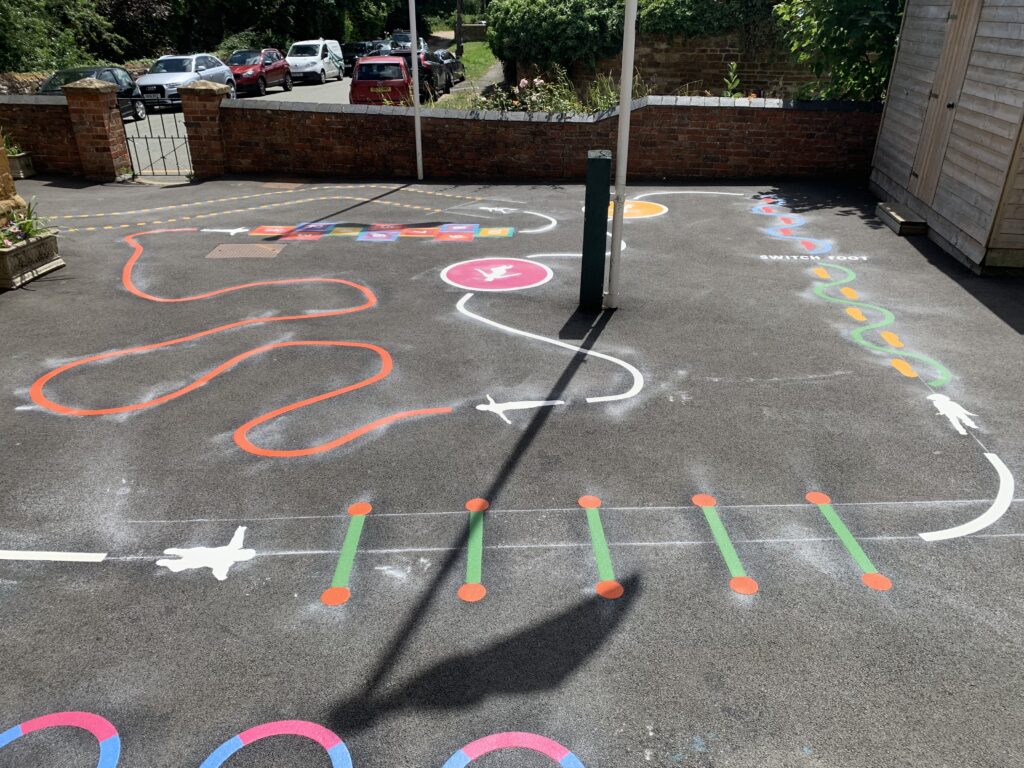
The playground markings that make a school playground more inclusive are sensory paths, high-contrast mobility-friendly routes, symbol-based communication designs, calm zones, adapted traditional games and group play zones, each chosen to remove a particular barrier to play.
Sensory paths and tactile games
Sensory pathways engage children through movement, colour and touch, and help pupils with sensory processing differences regulate themselves during playtime. Tactile games and textured designs add a multi-sensory element for children who learn best by doing. Our sensory and SEND playground markings are designed with these needs in mind.
High-contrast and mobility-friendly pathways
Clear pathways in contrasting colours help children with visual impairments find their way around and help pupils using mobility aids or wheelchairs move comfortably between areas. These routes can link games, puzzles and activity zones, so accessibility never comes at the cost of fun.
Symbols and visual communication
Universal symbols, directional arrows and communication-friendly designs let children understand a game without relying on spoken instructions. This helps pupils with speech, language and communication needs, and children who are still learning English, join in with confidence.
Calm and quiet zones
Gentle colours and soft patterns can mark out a calm zone where children who feel overwhelmed by sensory overload can relax and regroup. Giving these areas a clear boundary tells every pupil that the space is for quieter play.
Adapted traditional games
Hopscotch, snakes and ladders and mazes encourage children to play together and learn from each other. Larger, clearer markings and layouts that leave room for mobility aids make these familiar games open to more pupils.
Interactive group play zones
Zones for group games, puzzles and collaborative activities encourage cooperation, communication and teamwork, and give children a natural reason to play with someone new.
How does inclusive playground design support pupils with SEND and SEMH needs?
Inclusive playground design supports pupils with SEND and SEMH needs by matching specific markings to specific barriers, such as calm zones for sensory overload, symbols for communication needs and contrasting routes for visual impairment, so each child has a way into play.
| Pupil need | Markings that can help |
|---|---|
| Autism and sensory processing differences | Sensory paths, calm zones in gentle colours, clearly bounded areas |
| Speech, language and communication needs | Universal symbols, sign language symbols, directional arrows, emotion characters |
| Social, emotional and mental health (SEMH) needs | Emotion markings such as Colour Creatures, quiet spaces, cooperative games |
| Visual impairment | High-contrast pathways and colour-coded routes |
| Physical disabilities and mobility aids | Wide, clear routes, larger game layouts, accessible sports and activity zones |
| Diverse learning needs | Educational games with large, bold numbers and letters |
Our team has experience working with special schools and SEN organisations, and we can work alongside providers of specialist SEN playground equipment so the markings and equipment form one inclusive space.
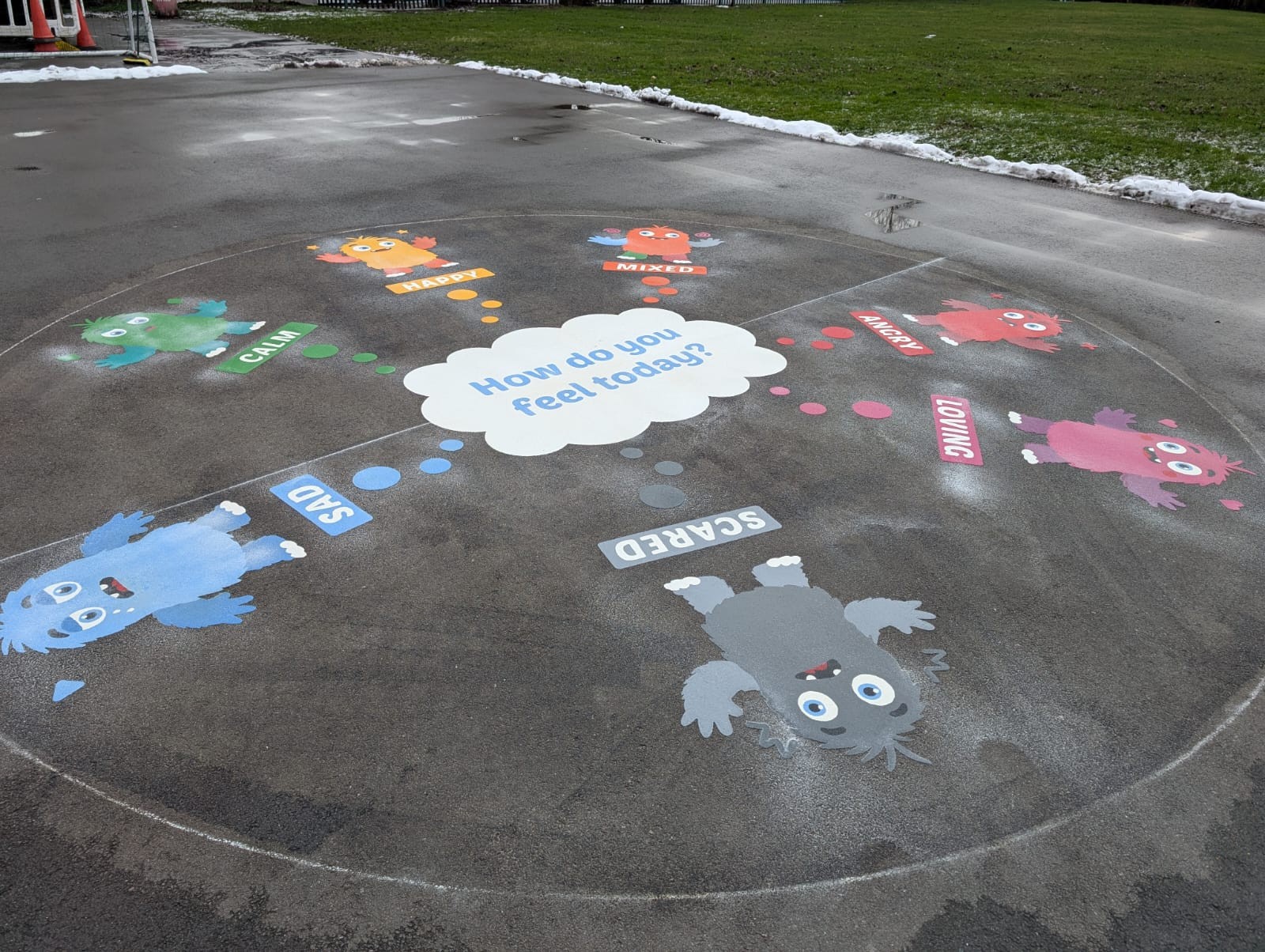
How do emotion markings like Colour Creatures support wellbeing in the playground?
Emotion markings support wellbeing by giving children a clear, non-verbal way to recognise and express how they feel during playtime, and our Colour Creatures design does this by linking colours and friendly characters to different emotions.
Children feel a wide range of emotions while they play, from excitement and joy to frustration, anxiety and uncertainty. For many children, particularly those with SEMH needs, autism or speech and language needs, naming and communicating those feelings is hard. Colour Creatures gives emotions a visible presence on the playground, so children are encouraged to pause, reflect and show how they feel, which supports emotional regulation and self-awareness.
When children can recognise their own feelings, they are better able to understand the feelings of others. That encourages empathy, kindness and respectful communication, which helps reduce playground conflict. Children who feel emotionally secure at playtime are more likely to come back to the classroom settled, focused and ready to learn, so emotion markings support behaviour and engagement across the school day.
Colour Creatures can be installed as a standalone feature or as part of a wider inclusive scheme, alongside physical activity zones, quiet spaces and social play areas. Used together, these support a school's wider wellbeing, inclusion and personal development priorities.
How does inclusive playground design give every pupil equal opportunities for active play?
Inclusive playground design gives every pupil equal opportunities for active play by offering a wide variety of markings, so the sporty child, the creative child and the child who prefers quieter or learning-based games all find something that gets them moving.
Health experts recommend that children are active for at least an hour a day, and active play helps children develop emotionally and build social and problem-solving skills. The UN Convention on the Rights of the Child recognises every child's right to play, and that includes children with disabilities. In practice, a diverse playground might include:
- Active play markings such as hopscotch, running track markings and fitness circuits, which build healthy habits and support concentration and mood.
- Sports areas such as multi-use games area (MUGA) markings, which introduce pupils to a range of sports and keep children of all abilities involved in sport.
- Accessible sports and activity zones outlined so that children with physical disabilities can take part, which boosts self-esteem and encourages friendships between children with and without disabilities.
- Artistic and themed designs with bright colours and characters for children who are drawn to creative and imaginative play.
- Educational playground markings such as number grids, alphabet tracks, maps, word-building games and simple words in more than one language, which reinforce the curriculum and help children from different linguistic backgrounds join in.
What should a school consider when planning an inclusive playground?
A school planning an inclusive playground should consider the full range of ages and abilities on site, involve the people who know the children best, and balance active, social and quiet areas so that no single type of play takes over the space.
- Consider the ages and abilities of your pupils: many schools cover a wide age range, so choose markings that offer equal opportunities for play to younger and older children.
- Involve the school community: teachers, parents, therapists, disability advocates and, most importantly, the children themselves can tell you what will and will not work.
- Use colour and themes: bright colours and characters keep a range of pupils engaged and promote creative play and social skills.
- Balance the zones: plan space for active games, social play and calm retreat, and link them with clear routes.
- Customise for individual needs: colour-coded paths for children with visual impairments, or designs built around a pupil's special interests, can make a real difference for individual children.
How can school staff encourage every child to join in active play?
School staff can encourage every child to join in active play by taking part themselves, giving children choices and using gentle prompts, because markings work best when adults actively support the games around them.
- Join in with outdoor games and show that you enjoy them.
- Let children make their own choices during playtime.
- Watch how children engage with play and notice who is left out.
- Use verbal and non-verbal prompts to encourage active play.
- Lead some outdoor activities and plan a timetable of playground games.
- Make activity cards to use alongside the markings.
- Include physical activities in special events and family events at school.
- Recommend clothes and shoes that let children move freely.
- Make simple charts to track children's physical activity.
How does Uniplay design inclusive playground markings?
Our in-house design team creates bespoke inclusive playground markings for early years settings, primary schools, secondary schools and special schools, planning each layout around the pupils who will use it and the space available.
Our team can visit your school to assess the area and suggest designs, and we can fit our markings into new or existing playgrounds, either as single features or as part of a wider inclusive scheme. Thermoplastic markings are durable, and they are ready to use within 30 minutes of installation, which keeps disruption for pupils who find change difficult to a minimum. To talk through your inclusive playground, call our team on 0333 321 6699 or email [email protected].
Ready to transform your playground?
A free design and a detailed quote, with no hidden costs and our price match promise.
All prices include installation, and every quote is fully itemised.
- Free design and site survey
- No obligation
- Our own in-house installation team
More from the blog
Learning with math playground clock games
Math playground clock games continue to be one of the most sought-after playground markings, with many teachers keen to develop their pupil’s understanding of
Maths Playground Markings: Games, Ideas and Curriculum Links
Maths playground markings turn the playground into an outdoor maths lesson. Designs, games and curriculum links for EYFS, KS1 and KS2.
MUGA Markings: Creating a Multi-Use Games Area for Schools
What a MUGA (multi-use games area) is, which sports and drills its markings can include, how schools use one and how a new MUGA is funded.