School Playground Ideas for Primary Schools and Nurseries
School playground ideas are practical ways to turn a plain tarmac yard into a space where pupils move, play, learn and get along with each other. For most primary schools and nurseries, the simplest and longest lasting way to do that is with thermoplastic playground markings laid straight onto the existing surface.
Heads, PE leads and school business managers ask our team for ideas all the time. Below are the ones that work best in the playgrounds we design and install, how to fit them together on one site, and how schools get use from them well beyond breaktime.
What are the best school playground ideas for primary schools?
The best school playground ideas for primary schools mix active games, learning markings and spaces for imaginative and quiet play, so every pupil finds something to do whatever their age, ability or mood that day. These are the ideas we install most often.
Hopscotch and traditional games
Hopscotch is a classic for good reason. It builds balance, coordination and counting, and children teach each other the rules without an adult needing to step in. Alongside hopscotch playground markings we lay snakes and ladders, noughts and crosses, twister and 3-way hopscotch, which lets more children join the same game. Our designers often give traditional games a modern twist with characters, wording and bold colours, so a game parents remember still feels new to pupils.
Number grids and alphabet games
A number grid or alphabet grid is a game and a teaching tool at the same time. Pupils can hop to a letter that starts a given word, add up the numbers in a row or count in steps across the grid. Alphabet snakes, number ladders and number grid playground markings can be matched to what each year group is learning in class.
Target games
Target throw games such as dartboards and target hoops build hand-eye coordination and focus. They also work as maths tools, because pupils keep score, add, subtract and multiply as they play.
Mazes
A maze gives children a puzzle to solve on foot. It builds problem-solving and decision-making, and we can size and shape the design to suit younger or older pupils and the space you have.
Fitness trails and mile tracks
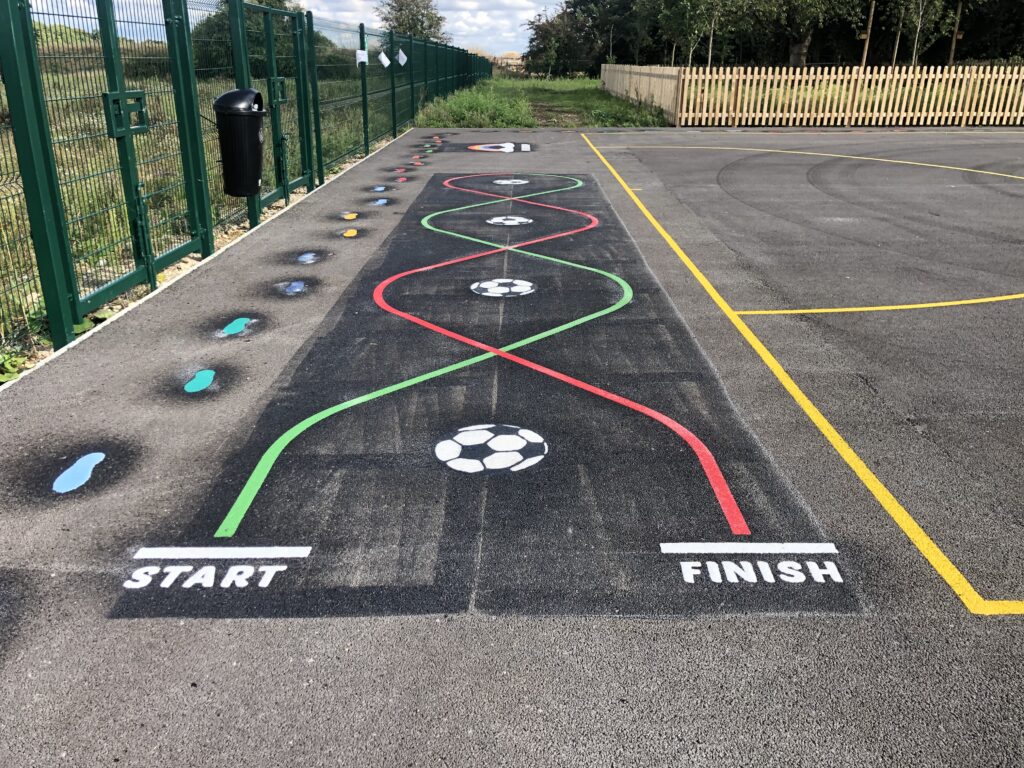
A fitness trail sets out a route of exercises such as jumping, hopping and skipping, so children can work their way round on their own or in small groups. A mile track, often used for The Daily Mile, shows pupils how far they have walked, run or skipped (see our Daily Mile track markings), which helps them set their own goals. We design trails and tracks around characters and themes, including video game themes, so pupils want to keep using them.
Roadways and roundabouts
Roadway and roundabout markings create a mini road system for bikes, scooters and imaginative play, which builds gross motor skills and balance. Many of our schools also use them to teach road safety in a safe, informal setting before pupils deal with real traffic.
Sports courts and multi-use games areas
Sports court markings for football, basketball, netball and tennis give older pupils structured games at breaktime and get used again in PE lessons and after-school clubs. Where space allows, a multi-use games area (MUGA) combines several sports on one surface. Bright colours and courts that interweave with other designs help pupils who are not drawn to team sports find something they enjoy too.
Themed and imaginative play areas
Themed markings such as pirate islands, castles, fairy gardens or space adventures invite children into role play. Children make up their own stories, take on roles and work together to build their imaginary worlds, which develops creativity, language and social skills.
Sensory, nature and quiet areas
Not every child wants to run around at breaktime. Sensory paths, tactile games and quiet zones give pupils who feel overwhelmed somewhere calmer to be, and our sensory and SEND playground markings are designed with pupils with special educational needs and disabilities in mind. Many schools place these areas near planting, sandpits, water play or a mud kitchen, and add a small counting or hopscotch marking nearby.
How should a primary school zone its playground so every pupil has something to do?
A primary school should zone its playground into separate areas for active play, learning games, imaginative play and quiet time, because clear zones stop one activity, usually football, from taking over and give every pupil a place that suits them.
- Active zone: courts, trails, targets and running games for pupils who want to move.
- Learning zone: number grids, alphabet paths, world maps and clocks, ideally close to classrooms so teachers can use them in lessons.
- Imaginative zone: themed markings, roadways and role-play areas.
- Quiet and inclusive zone: sensory games, seating and calm space for pupils who need a break from noise.
Markings can also set out safe walking routes, traffic lanes and the edges of each zone, so the playground stays organised and children move around safely. Benches or circular seating give children a place to sit and talk, and trees, shrubs and green space bring nature into the design. Inclusive zones with group games such as 3-way hopscotch, noughts and crosses and twister encourage children who might not normally play together to mix.
Seating, planting and play equipment that all children can use, including children with physical disabilities, matter as much as the markings. We design the markings around whatever you already have on site.
How can school playground ideas support learning across the primary curriculum?
School playground ideas support learning across the primary curriculum by putting maths, literacy, geography and science onto the playground surface, so pupils practise classroom skills while they play and teachers can take a lesson outside without extra equipment.
We call this covert learning: children think they are playing a game, but they are also counting, reading, reasoning and remembering. Examples we install include:
- Maths: target games for scoring and times tables, a 24-hour clock, a Carroll diagram, a fraction caterpillar and number grids for addition, subtraction, multiplication and division. Teachers also use markings to explain fractions, decimals and percentages.
- Literacy: alphabet paths, letter games and word games for letter recognition and spelling practice.
- Geography: world maps, UK maps and compass markings for teaching location, distance and direction.
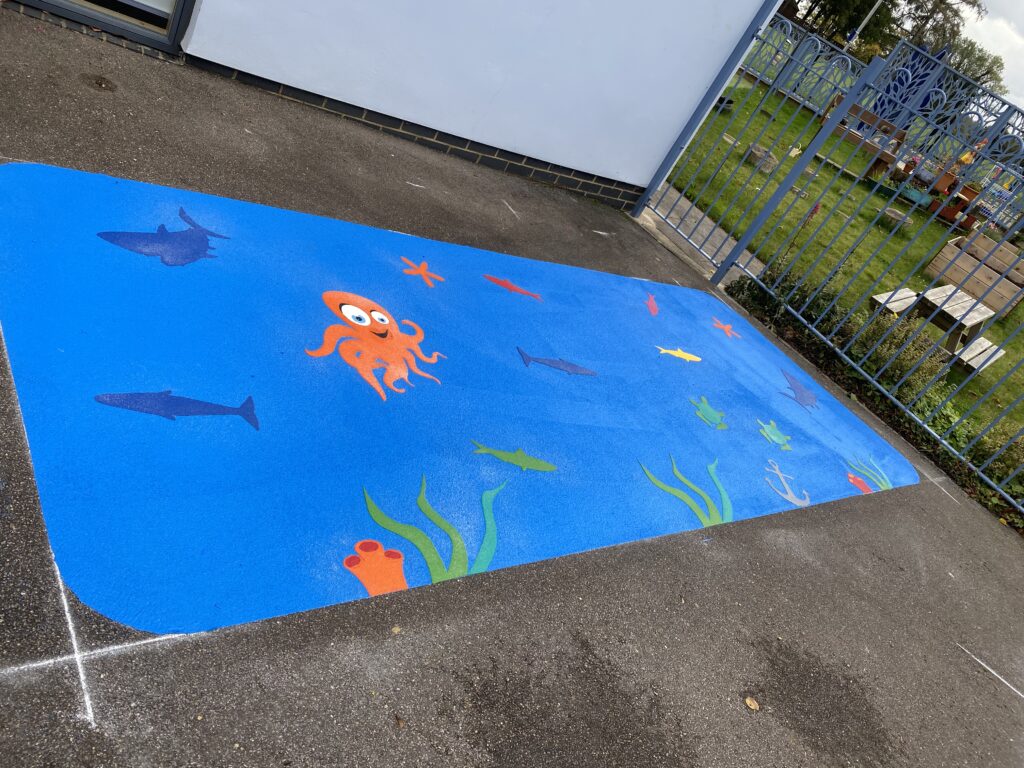
- Science and the environment: a solar system for pupils to walk through, or markings that show ecosystems such as a rainforest or coral reef, so pupils can talk about the species that live there and how human activity affects them.
Because our team designs everything in house, we can build markings around your school's curriculum or learning objectives rather than asking you to pick from a fixed catalogue.
How can school playground ideas help pupils be more active at breaktime?
School playground ideas help pupils be more active at breaktime by giving them games they can start on their own, such as trails, mile tracks, courts and targets, which turns unstructured time into regular movement without an adult having to organise it.
Many primary schools are working towards an hour of physical activity a day for every pupil, and PE lessons alone rarely cover that. A mile trail used during independent play, or an active zone with skipping and jumping spots, adds movement every single day. The same markings carry on working in PE lessons and after-school clubs.
Breaktime is also the only unstructured part of the school day for most children. An engaging playground helps them let off steam, so they come back to class ready to focus, and it gives them practice at communicating, sharing and taking turns.
How can primary schools use playground markings beyond breaktime?
Primary schools can use playground markings beyond breaktime in lessons, after-school clubs, sports day, sporting clubs and wellbeing sessions, which means the same markings earn their place several times a day rather than only at play.
- After-school clubs: a dance club can build a routine around hopscotch markings, and a science club can explore a solar system marked on the ground.
- Sports day: a giant chess board where pupils act as the pieces, or a mini-golf course that needs precision and teamwork.
- Sporting clubs: football and netball sessions can use court lines and markings for agility and running drills.
- Mental health and wellbeing: a feelings wheel where children talk about how they feel, or a gratitude path where pupils say what they are grateful for.
- Art: dot-to-dot style markings for drawing games, or a marked area that children use as a giant canvas for their own murals.
Why are thermoplastic playground markings a good fit for school playground ideas?
Thermoplastic playground markings are a good fit for school playground ideas because they are heat-applied straight onto tarmac or concrete, take up no extra space, stay bright and slip-resistant, and keep their colour under heavy daily footfall for years.
- Our markings carry a manufacturer's warranty of up to 4 years, subject to ground condition, and we have seen them last over 10 years.
- Installs are ready to use within 30 minutes, so we can work around the school day.
- Prices start from around £50 for a single design (indicative, excluding VAT), so you can begin with a few games and add more later.
- They need very little maintenance and outlast painted lines by a long way.
You can browse our full range of thermoplastic playground markings, from traditional games to bespoke designs, to see what would suit your site.
How do we help schools plan their playground ideas?
Our team helps schools plan their playground ideas through a design consultation, in-house design and installation by our own installers, so one company takes the project from the first conversation to the finished markings.
We start with what you want the playground to do: more activity, more learning outside, calmer breaktimes or better social play. We then look at your space, your age groups and any equipment already in place. Many schools involve pupils in choosing designs, and some ask us to include the school logo or colours. Because we design everything from scratch, if you have an idea of your own we can usually bring it to life.
To talk through ideas for your school playground, call our team on 0333 321 6699 or email [email protected] and we will be in touch as soon as possible.
Ready to transform your playground?
A free design and a detailed quote, with no hidden costs and our price match promise.
All prices include installation, and every quote is fully itemised.
- Free design and site survey
- No obligation
- Our own in-house installation team
More from the blog
Small Playground Ideas for Schools with Limited Space
Small playground ideas for schools: multi-use markings, scaled-down games and smart zoning to get more play and learning from a compact space.
St Barnabas get active with 1k a day
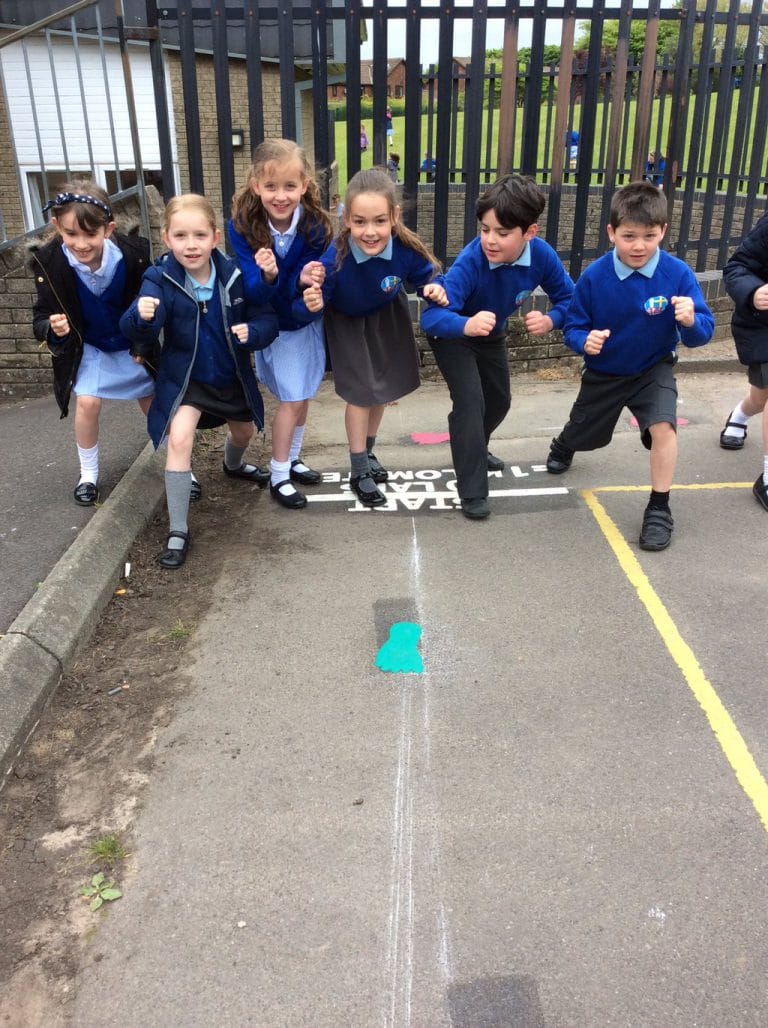
Uniplay were delighted to be asked to install a 1 kilometre circuit in thermoplastic footprints at St Barnabas Primary School in Darwen.
Supporting Sport and Physical Development Clubs
We absolutely love to promote grassroots sport and physical development in young people, and whenever possible try to assist in promoting all types of sport