
We mark full basketball courts, half courts and single keys in hard-wearing thermoplastic on school playgrounds across the UK and Ireland, and our own DBS-checked team lays every one. The survey is free, and we tell you honestly which court your playground can take.
Popular basketball designs we install, with guide prices. Every project is quoted after a free survey and design.
Basketball court markings are the thermoplastic lines that set out a basketball court on a playground: the sidelines and end lines, a centre line and circle, and at each basket a key, a free-throw line and a three-point arc.
We lay them in preformed thermoplastic, cut to shape before it reaches your school and heat-bonded to the tarmac.
The key is the rectangle in front of each basket. FIBA, the sport's world governing body, calls it the restricted area, and players also call it the paint.
Pupils use a marked court at break and lunch as well as in PE, and the UK Chief Medical Officers count that play towards an average of at least 60 minutes of moderate to vigorous activity a day for 5 to 18 year olds. Basketball is one part of our sports court and MUGA line markings.
Uniplay supplies and installs basketball court markings in three school layouts: a full 30m x 15m court with a key and three-point arc at each end, a half court around one basket, and a single key where only one hoop fits.
Our full basketball court marking adds the centre circle, halfway line and free-throw circles to those keys and arcs, all in red. It is the layout for 5v5 games, PE lessons and after-school clubs.
Where the playground is short of length, the basketball key and D marks one end of a court in a 13m x 8.5m area: the key, the free-throw circle and a large three-point arc called the D.
The single basketball key needs just 5m x 8m. It keeps the free-throw circle and adds the small no-charge semicircle under the basket, which is enough for shooting and layup practice.
A wall-mounted hoop or a lone post can work with no court at all. Our five basketball shooting spots are 0.4m orange ball markers set around the hoop, so pupils shoot from fixed distances.
Schools that teach netball, football or tennis on the same tarmac can choose a combined design: the netball and basketball court, the basketball and football court or the four-sport multi court, each in a 30m x 15m layout. If you are unsure which one fits, the free survey settles it.
A full-size basketball court measures 28m by 15m inside its boundary lines under the FIBA Official Basketball Rules 2026, and a competition floor adds at least 2m of clear space on every side, giving a minimum area of 32m by 19m.
Outdoor basketball court markings can work to a smaller standard. Sport England treats outdoor basketball as community play, and its comparative sizes give 26m x 14m as the minimum court and 28m x 15m as the preferred one, with 1.05m to 2.05m of run-off.
Half courts need far less room. Basketball England recommends 15m wide by 11m to 14m long, with at least 1m clear to the nearest obstruction, and keeps the key, free-throw line and three-point line at their official sizes even when the outer court changes.
Our full and combined designs are listed at 30m x 15m, the area each one covers on the playground, so the figure differs from FIBA's 28m court. We set the court out within the space you have, and a full competition court needs that extra run-off as well.
| Layout | Playing area | Clear space around it | Source |
|---|---|---|---|
| FIBA competition court | 28m x 15m | At least 2m (32m x 19m floor) | FIBA rules 2026 |
| Outdoor court, preferred | 28m x 15m | 2.05m (32.1m x 19.1m overall) | Sport England |
| Outdoor court, minimum | 26m x 14m | 1.05m (28.1m x 16.1m overall) | Sport England |
| Half court | 15m wide x 11m to 14m long | At least 1m | Basketball England |
| Uniplay full and combined courts | 30m x 15m layout | Within your playground | Uniplay |
| Uniplay key and D, or single key | 13m x 8.5m or 5m x 8m | Within your playground | Uniplay |
FIBA measures from the inner edge of the boundary lines. Sport England also lists a 13m x 14m half court. We confirm the exact setout at survey.
Basketball court lines mark the boundaries and scoring zones: sidelines and end lines set out of bounds, the centre line divides the halves, and the key, free-throw line and three-point line decide where players stand and what a basket scores.
Every line is 5cm wide under the FIBA rules. Where there is room we mark each one to its recognised size, and on a tight site the scaled plan shows what has been reduced before anything is laid.
Basketball court markings cost from around £125 for a set of five shooting spots to about £1,695 for a four-sport multi court, fitted, and our full 30m x 15m basketball court has a guide price of £745.
These are guide prices that include installation and exclude VAT. The final figure comes from the survey, because it depends on the size of the court, how many sports, lines and colours you want, and the state of the surface.
Half courts cost far less. A single key is £135 and the key and D is £225, which makes either a sensible first step for a small playground.
Combining sports costs less than marking them separately: our netball and basketball court is £1,095, against £1,290 for the separate netball and basketball designs. Ask us for a free survey and we will price the layout that fits.
| Design | What it marks | Layout size | Guide price, fitted (ex VAT) |
|---|---|---|---|
| Basketball Court | Full court, both ends | 30m x 15m | £745 |
| Basketball Key and D | One end with a three-point arc | 13m x 8.5m | £225 |
| Basketball Key | Key and free-throw circle | 5m x 8m | £135 |
| x5 Basketball Shooting Spots | Five ball markers around a hoop | 0.4m each | £125 |
| Netball / Basketball Court | Netball and basketball combined | 30m x 15m | £1,095 |
| Basketball / Football Court | Football pitch with basketball keys and arcs | 30m x 15m | £935 |
| Multi Court: Netball, Basketball, Tennis, Mini Football | Four sports in four colours | 30m x 15m | £1,695 |
Guide prices, fitted, excluding VAT. Your final price comes from the survey.
Basketball court lines can be any solid colour that stands out clearly from the surface: the FIBA Official Basketball Rules 2026 ask for 5cm lines in high contrast, with all boundary lines in one colour and each pair of markings matching at both ends.
So both keys share a colour, as do both three-point lines and both no-charge semicircles. FIBA allows the centre line and centre circle to differ from everything else.
Contrast is the test. The sportscotland basketball datasheet prefers white lines for basketball-only halls and black where a hall is shared with other sports. For outdoor shared courts, Sport England's surfaces guidance gives a rule of thumb of the most-used sport in white, the second in yellow, then blue, then red.
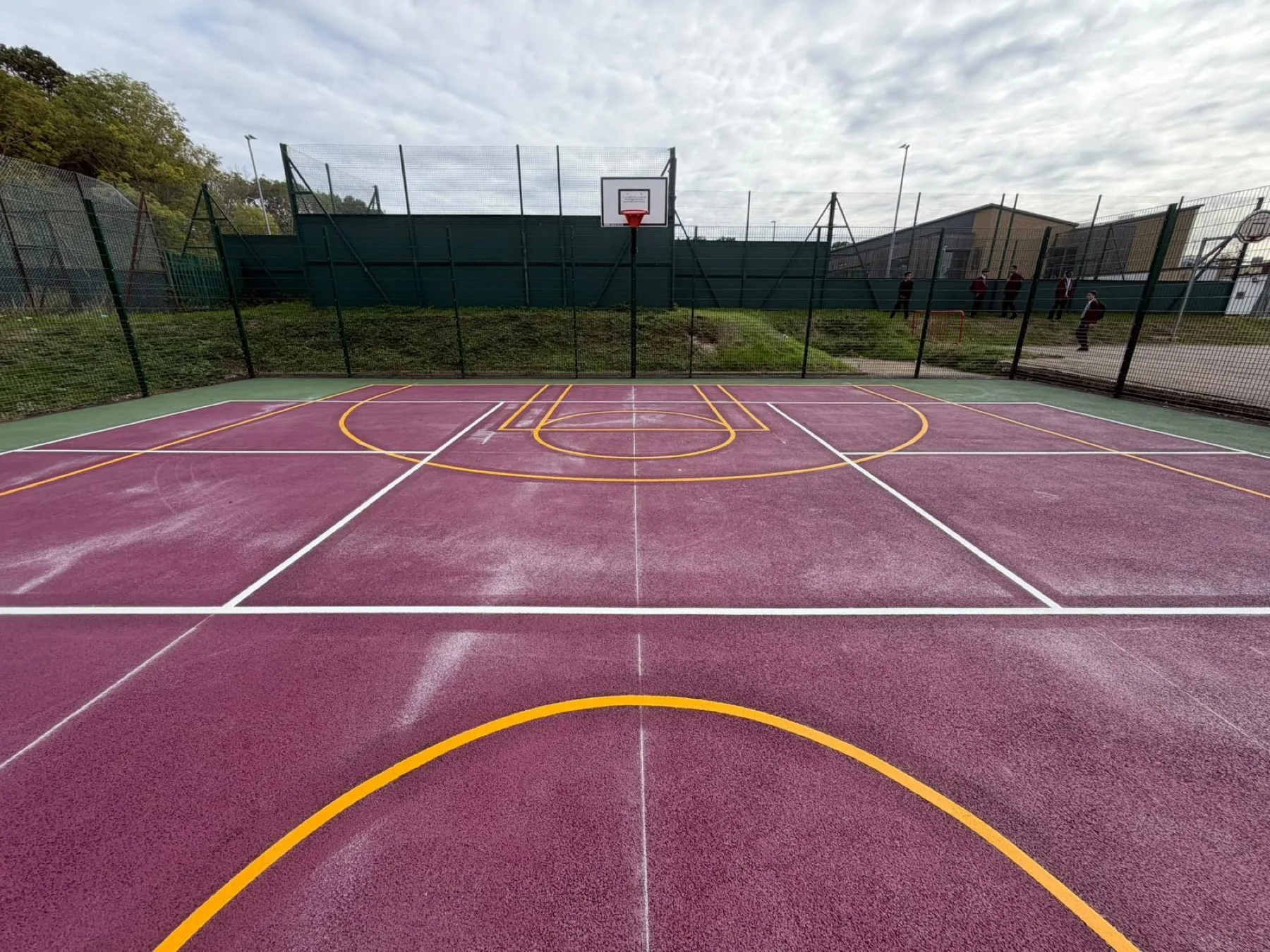
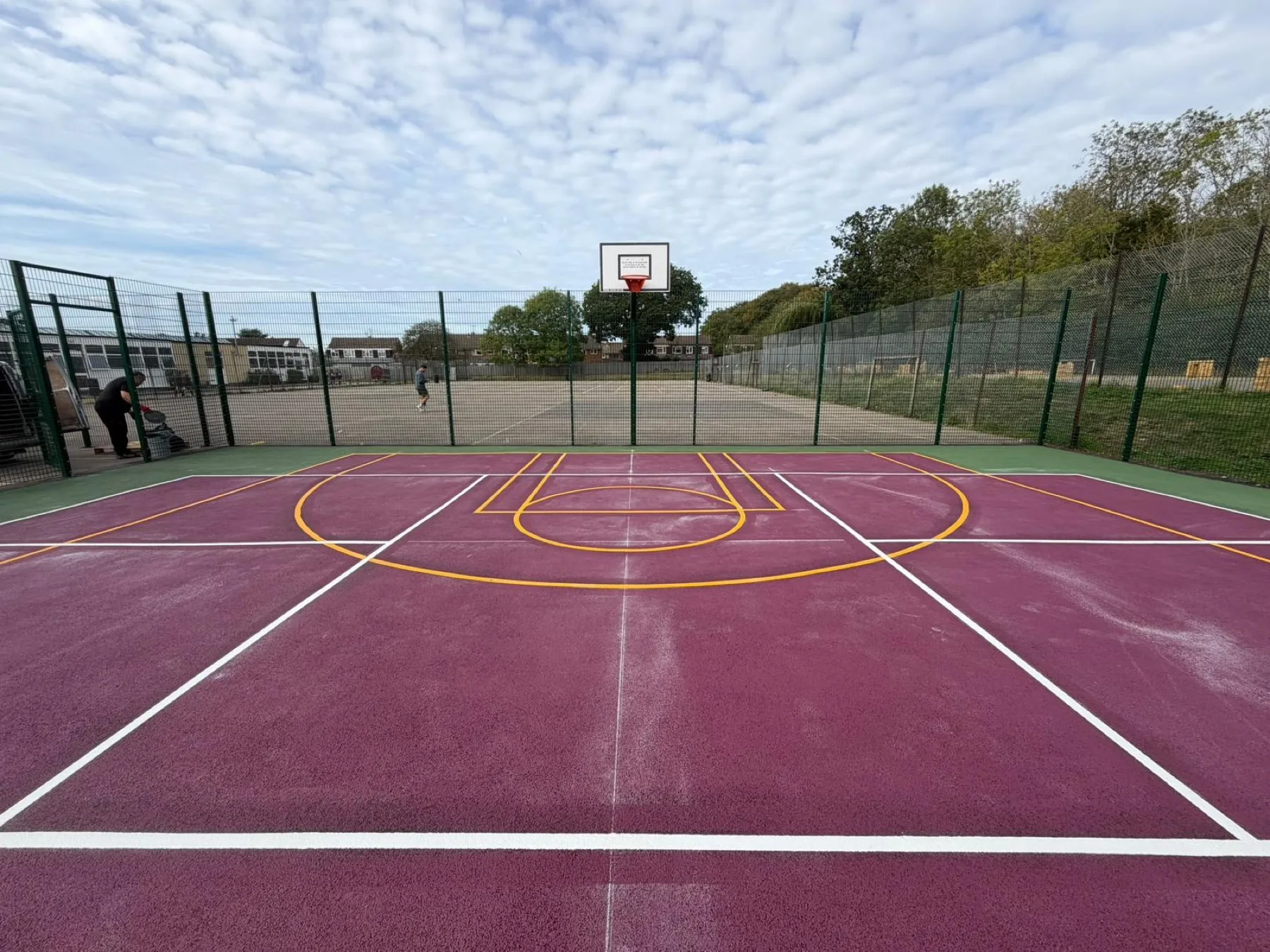
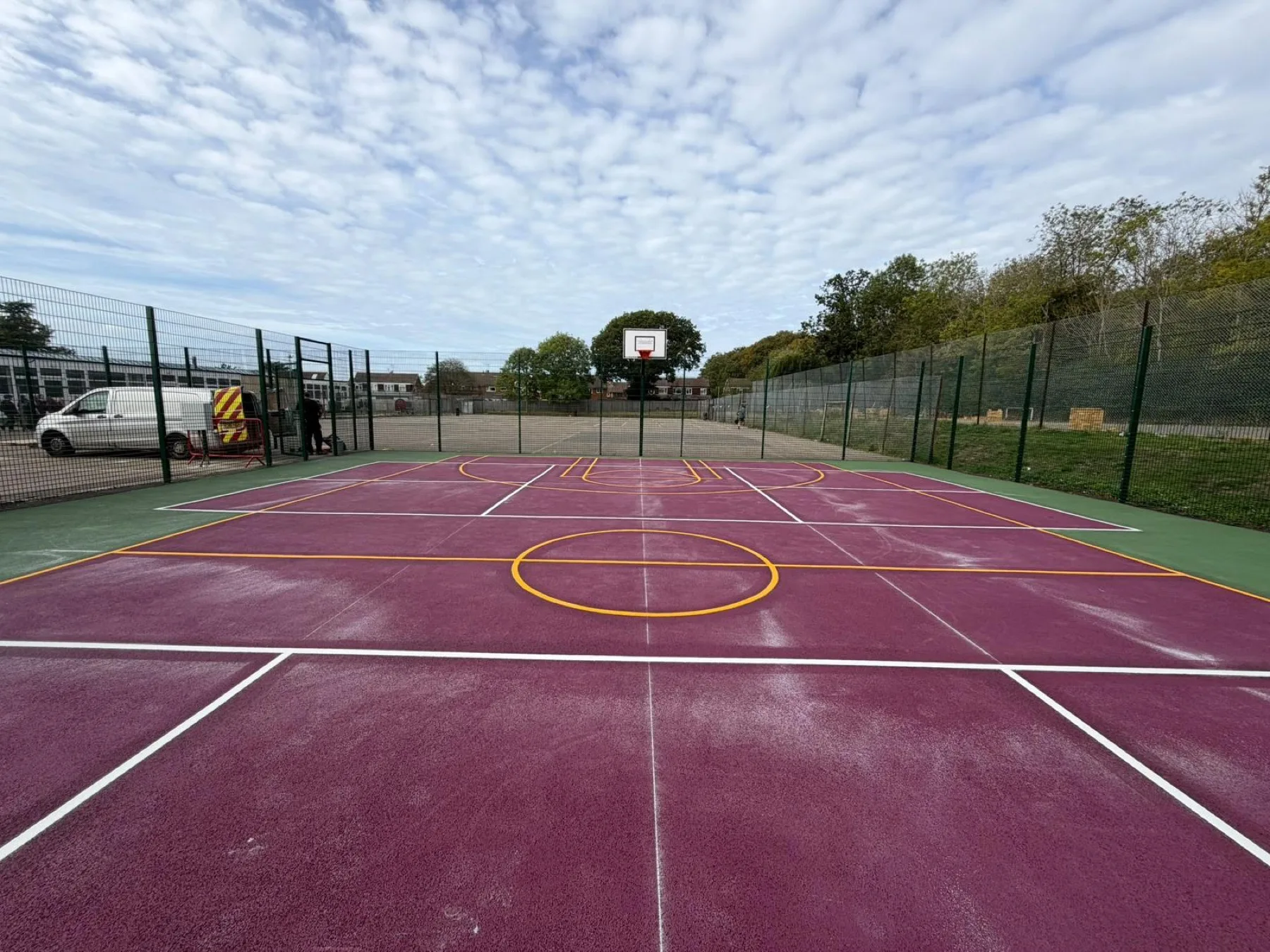
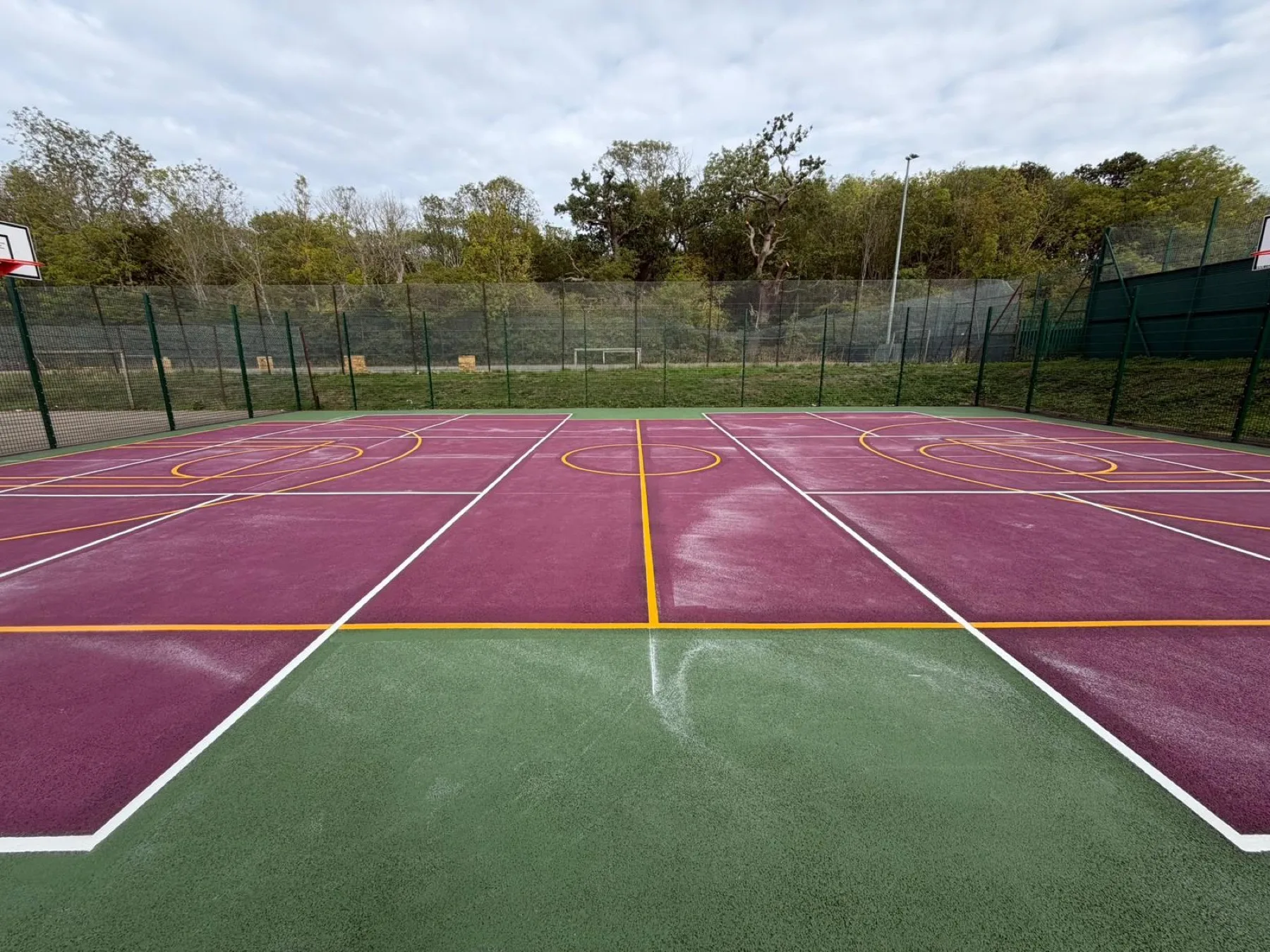
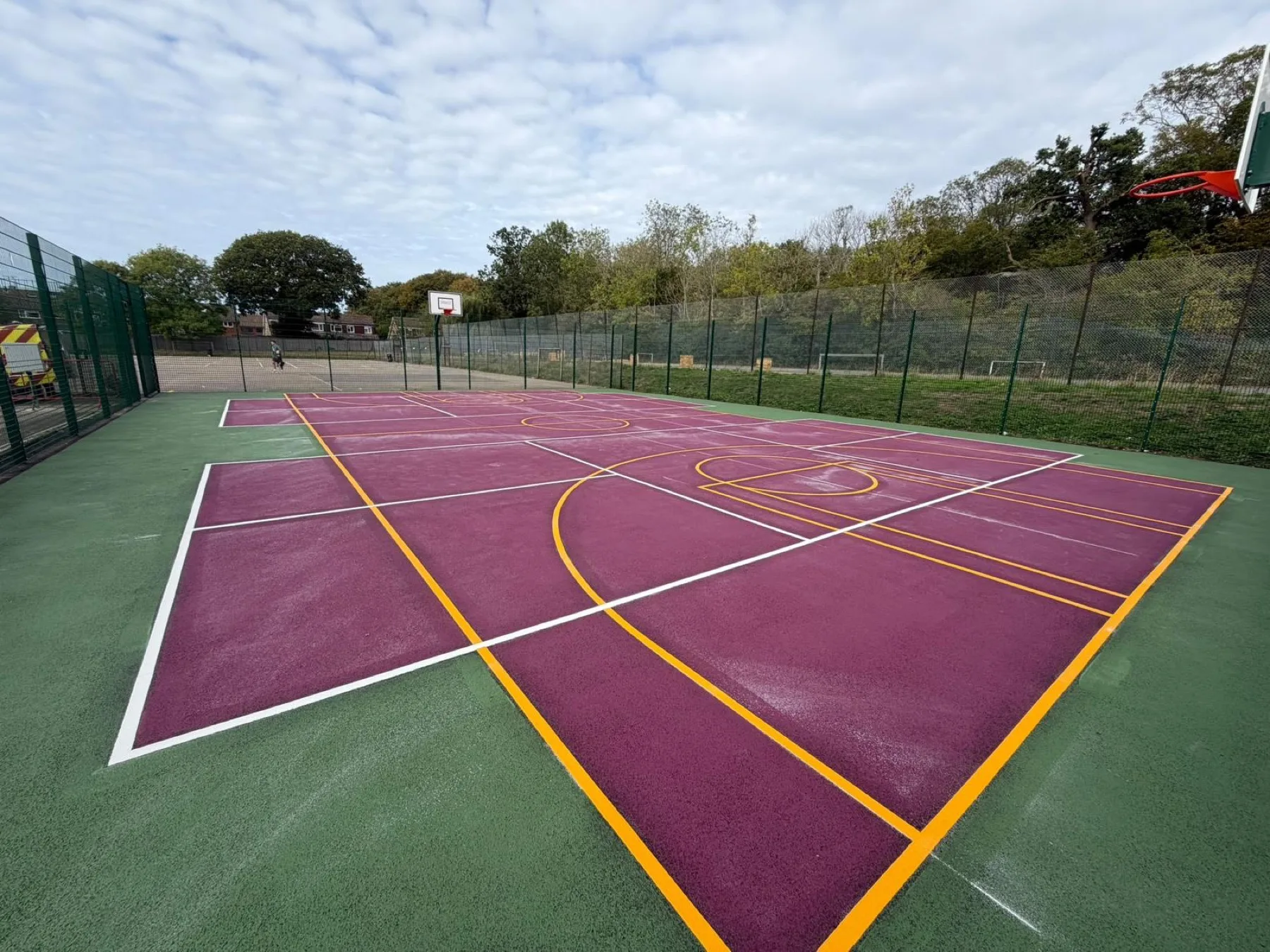
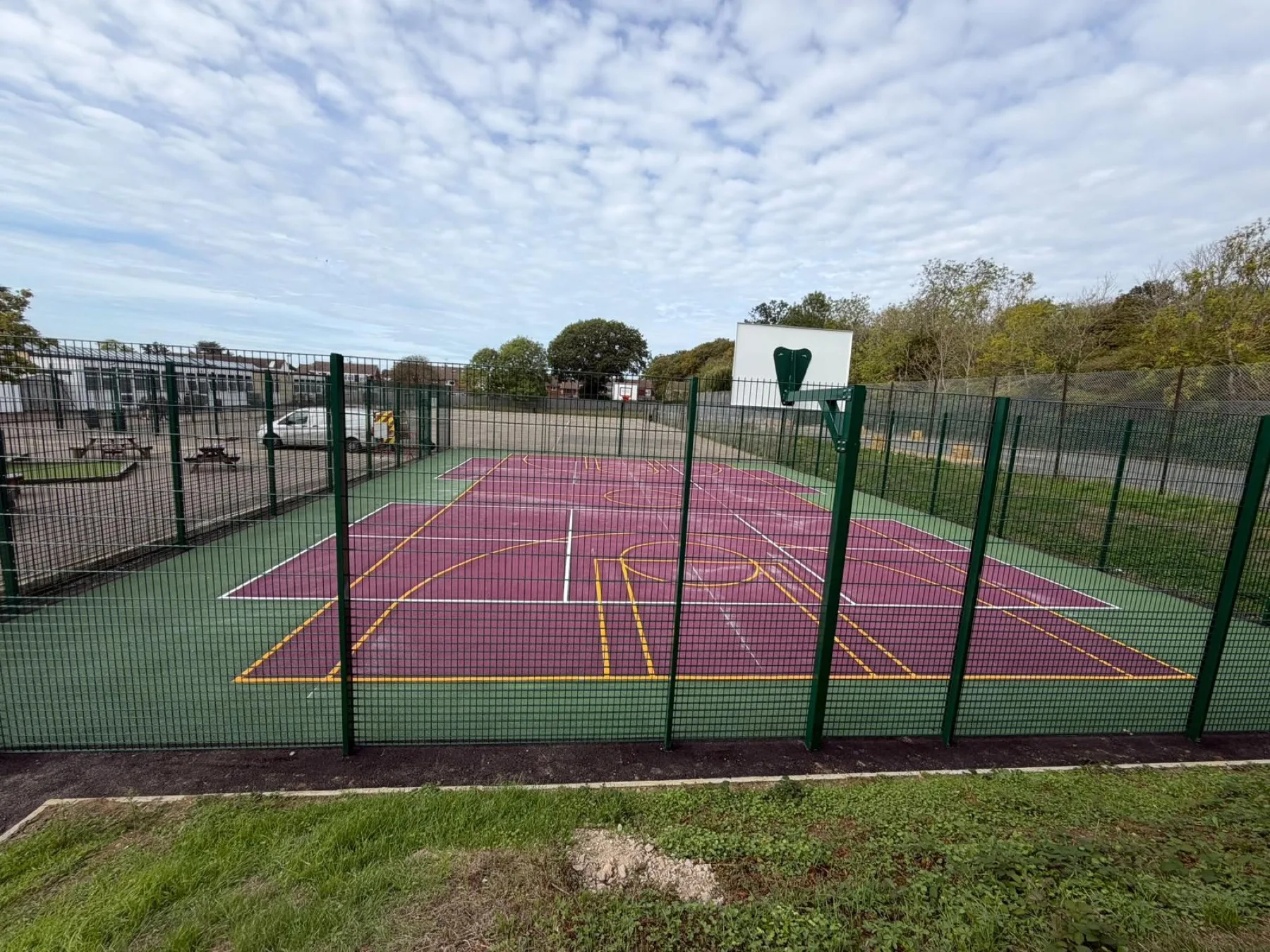
Our single-sport basketball designs are drawn in red, which reads clearly on black tarmac. On a coloured surface coating, such as the purple courts in our gallery, yellow and white lines stand out better.
Basketball court markings share space well with netball because a 28m x 15m basketball court fits inside the 30.5m x 15.25m netball court in Sport England's size guidance, so one rectangle of tarmac can carry both games in two line colours.
On a shared court the netball court lines divide the length into thirds and add a shooting semicircle at each end, while the basketball keys and arcs sit under the hoops. Add tennis or mini football and the space becomes a multi-use games area (MUGA) marking, with every sport in its own colour.
More sports means more lines to read. Sport England warns that overlapping lines make it harder for players to find their own, and advises against marking a sport for completeness if it will rarely be played. Every overlap shows on your scaled plan first, so PE staff can drop a sport they will rarely teach.
Basketball England notes that a MUGA built around a tennis court can leave the basketball court slightly longer than official size, which still suits recreational games.
Basketball court markings follow the FIBA Official Basketball Rules 2026, valid from 1 October 2026, which fix the court at 28m by 15m with 5cm lines, while Sport England, sportscotland and Basketball England publish the design guidance for school and community courts.
FIBA's equipment rules place the face of each backboard 1.2m in from the end line. The three-point arc and the no-charge semicircle are both measured from the point beneath the centre of the ring, so the lines and the post have to agree.
Sport England's comparative sizes accept other court sizes where a site needs them, as long as they are agreed with the governing body. The sportscotland datasheet sets 2m safety margins around a 28m x 15m court and measures its outer dimensions without the width of the lines.
Where there is room we mark to these recognised dimensions. For a court that will host formal competition, we confirm the exact standard you need at survey and mark to it.
Basketball court markings are installed by our own DBS-checked team, usually in a day for a single court, with preformed thermoplastic heat-bonded to a setout your PE staff have already approved on a scaled plan.
Every basketball court line marking job starts with the survey. We measure the usable area, note the gradient, drainage and obstacles such as existing posts, and work out which courts fit properly and where lines can overlap.
The scaled court plan then shows every line and its colour, so staff can check the keys, arcs and run-off before anything is laid.
On the day we prepare the surface and lay the thermoplastic, which arrives cut to shape and bonds to the tarmac under heat. The lines are ready to use within about 30 minutes, once they have cooled, and a full MUGA takes a little longer than one court.
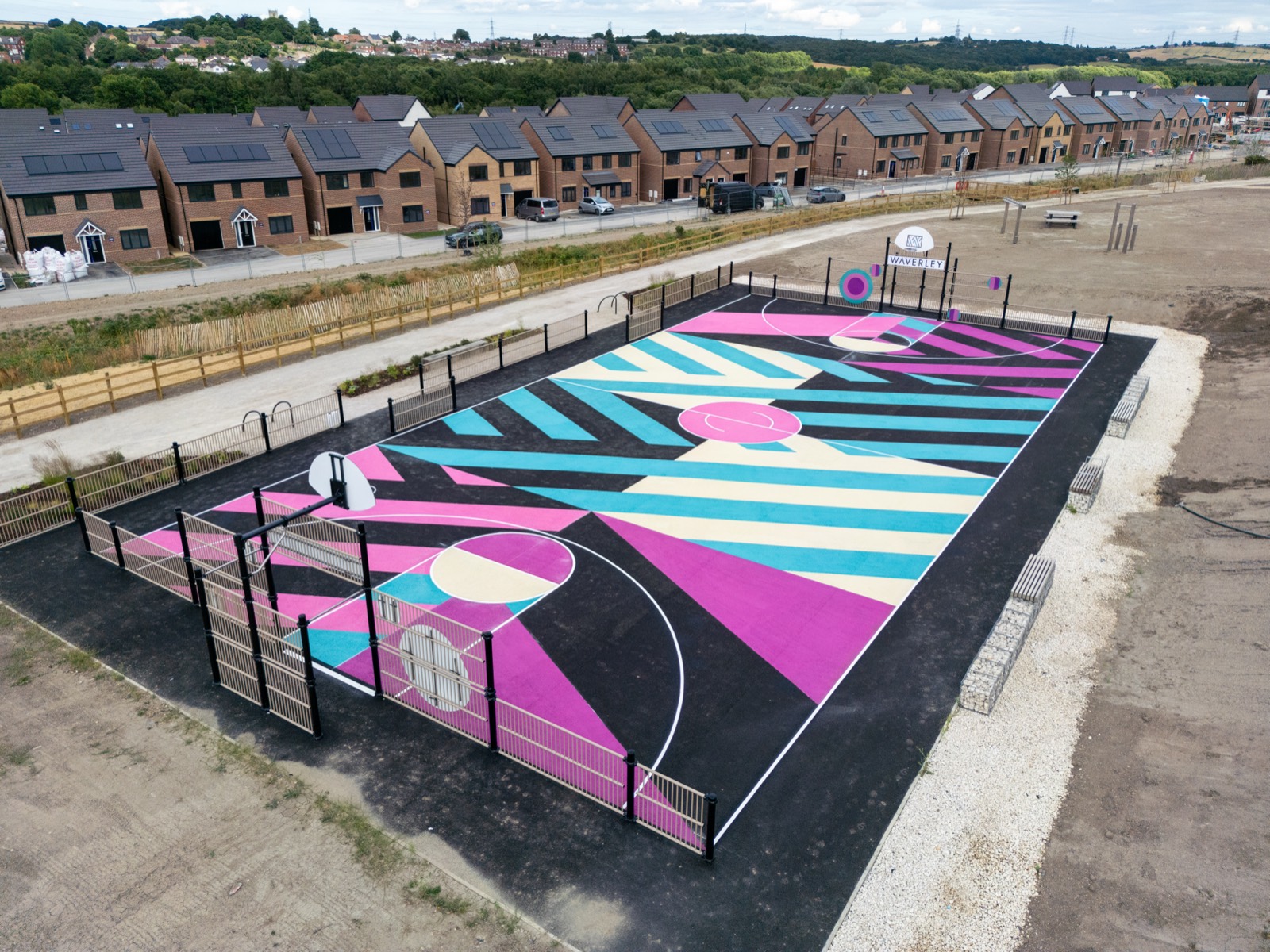
At Highwall Park MUGA in Rotherham we worked for Proludic: our team prepared the surface, applied an Xtreme coating and then laid preformed thermoplastic sports markings, with white basketball lines over pink, turquoise and cream stripes.
Basketball court markings in preformed thermoplastic carry our warranty of up to four years, subject to the condition of the ground, and we have seen them last for more than 10 years.
Our thermoplastic lasts up to 10 times longer than ordinary paint. Basketball puts that to the test: pupils stop, pivot and slide on the same key every lesson, and thermoplastic takes that scuffing far better.
The ground sets the limit. The warranty depends on the condition of the tarmac underneath, so we look at it during the survey and tell you if it needs repair first.
When lines do wear, we can refresh them on a return visit.
Uniplay designs and installs basketball court markings for schools, nurseries and councils across the UK and Ireland from our base in Blackburn, Lancashire, with every installation carried out by our own in-house team.
That team is DBS checked as standard. We are a Constructionline Silver Member and a CHAS Accredited Contractor.
We also tell you plainly what fits. If your playground cannot take a full court with proper run-off, we say so at survey and show the half court or key that will work. Stephen Draper, headteacher at Banks Methodist Primary School in Southport, said we were “honest and open about what would work”.
Every design on this page has a published guide price, from five shooting spots to a four-sport court. The survey, the scaled design and a detailed quote are free, with no hidden costs and our price match promise, so book a survey and we will draw a court plan for your playground.
| Detail | What we provide |
|---|---|
| Material | Preformed thermoplastic, heat-bonded |
| Guide price | £125 to £1,695 fitted, ex VAT |
| Full court design | 30m x 15m layout |
| Half court and key | 13m x 8.5m or 5m x 8m |
| FIBA court | 28m x 15m, 5cm lines |
| Install time | Usually a day for one court |
| Warranty | Up to 4 years, subject to the ground |
No. We mark the court lines, and posts, rings, backboards and nets come from an equipment supplier. Basketball England's outdoor guidance favours galvanised steel posts set in 1m of concrete, with at least 1.2m of overhang from the post to the backboard. Ground sleeves let a post be lifted out when the space is needed for other sports.
Yes. Our survey records existing posts along with the gradient and drainage, and we set the keys out to line up with them. If a post stands where a full court cannot line up, the scaled plan shows what can work instead, such as a key and D at that end or two half courts.
Basketball England's outdoor guidance gives 3.05m as the standard ring height and 2.60m as the junior height. FIBA's mini-basketball coaches manual suggests going lower for young children where the basket adjusts, to 2.43m for under-10s and 1.83m for under-6s. Lowering a ring moves none of the lines, and the post sets the height, so agree it with your equipment supplier.
Basketball England recommends at least 9m x 9m of uninterrupted space, even for a single hoop. Inside that, our Basketball Key needs a 5m x 8m area and each of the five shooting spots is 0.4m across, so one post at the edge of a playground can still host shooting practice and games of 1v1 or 2v2.
For a new court, usually not. The Department for Education's guidance, updated in September 2026, bars capital spending and lists multi-use games areas as an example, but it treats repainting lines on an existing playground as routine maintenance. New courts tend to come from capital or premises budgets, PTA fundraising, council or community grants and charitable trusts. We explain the rules on our <a href='/sports-premium/'>PE and sport premium funding for playground markings</a> page.
A sound, free-draining tarmac or macadam surface. Basketball England prefers porous macadam for outdoor basketball because it gives a good bounce, resists slipping and drains quickly, and it advises against sand-filled or synthetic turf and needle-punch surfaces. If the tarmac is worn or patchy, our full-colour surface coatings can renew it before the lines go down.
Yes. The thermoplastic we use is non-toxic and free of lead, chromates and solvents, and it has an anti-slip, skid-resistant textured finish for running, stopping and turning. Keep the court swept, though: Basketball England notes that leaves and debris from overhanging trees can make an outdoor court slippery.
Yes. A return visit can add a sport or extend a court, so a school can start with a single key or the shooting spots and add the second key and the full court lines when the budget allows. Drawing the whole court on the first scaled plan keeps the later lines in the right place.
A full game is 5v5, so one court takes 10 players at a time. Split at the centre line, each end can host a 3x3 game, the half-court format that Basketball England's guidance sets on a 15m x 11m court, so 12 pupils play at once. Add the five shooting spots and a hoop doubles as a skills station between games.
Tell us about your space. We survey and send a free design and a detailed quote, with no hidden costs and our price match promise.
All prices include installation, and every quote is fully itemised.

Our full range of playground markings in one free PDF, yours to browse and share with your team.
Free brochureGet a free design and quote